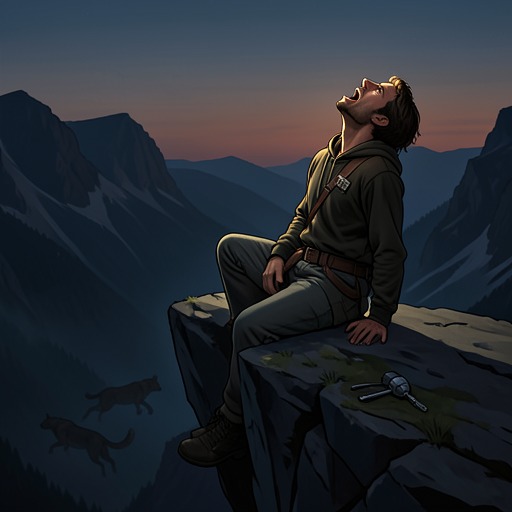
Grainier's Encounter with the Wolf-Girl
Train DreamsGrainier's Encounter with the Wolf-Girl is a decisive encounter between Robert Grainier and the daughter he believed had died in the Moyea Valley fire. A pack of wolves sweeps through the clearing after a night of extraordinary animal cries, leaving behind an injured child whose body and behavior are wolf-like but whose identity Grainier knows immediately as Kate. He rescues her, treats her shattered leg, and briefly restores her to human shelter; at daylight, however, she leaves through the window and returns toward the river. The event turns grief into recognition without restoring the lost family, and it gives Grainier's later life in the burned valley its most intimate and haunting purpose.
Causes and Background
The encounter occurs roughly a decade after the great fire that destroyed Grainier's homesite and killed Gladys Grainier and the infant Kate. Grainier had already made a life from the remains. After returning to the Moyea Valley, he raised a canvas lean-to, cut burned spruce, and built an eighteen-by-eighteen-foot cabin from fire-killed timber. The clearing was beginning to heal: fireweed and jack pine rose from the ashes, while butterflies, bears, birds, and other animals moved through the blackened country. Yet the new ecology was not a restoration of the old one. Spruce had disappeared, jack pine had replaced it, wolves were heard less often and from farther away, coyotes had multiplied, rabbits had grown scarce, and trout had vanished from stretches of the Moyea River.
Grainier's return was therefore an act of fidelity to a place that could not give back what it had taken. He had seen impossible signs of Gladys Grainier after the fire, including visions of her white bonnet passing overhead and chocolates apparently scattered across the clearing. He also heard wolves answering one another across the peaks, as though the burned valley retained a voice of its own. The wolf-girl's appearance extends this unstable border between memory, animal life, and physical return. She is not merely an apparition, because she has a broken leg and a body Grainier can lift; yet her presence makes the lost child seem to have survived in a form no human household could recognize.
The immediate setting is shaped by the death of Kootenai Bob. In the days after Kootenai Bob was killed beneath successive trains, the Great Northern Railway slowed its trains and sounded long whistle blasts so that the Kootenai people could search the tracks for his remains. On clear, cold mid-November nights, the whistles stirred the coyotes, then the wolves, and then what seemed like every vocal creature along the surrounding peaks and ridges. Grainier heard a chorus unlike any he had known, vast enough to resemble an announcement of the world's ending. The encounter begins within that atmosphere of mourning, disturbance, and collective animal alarm.
What Happens in the Clearing
The night of the full moon is the most intense of the sequence. The wolves and coyotes howl without interruption, seeming to number in the hundreds. Grainier feeds the stove, stands half-dressed in the cabin doorway, and watches the white moon erase the stars and reduce the mountains to gray silhouettes. A pack appears to approach at a run. The animals flood into and around the clearing, their voices screaming and their pads striking the earth; several brush against Grainier as they pass. Almost immediately they disappear, except for one figure: the wolf-girl.
Grainier is nearly overcome by the sight. The creature lies on her side, panting, apparently hurt. Her general form tells him that she is human, specifically a female child, but her limbs are bent and her breathing produces a whistling squeak like that of a frightened pup. Grainier initially turns back toward the cabin in search of a weapon. He has no shotgun and does not know what he expects to find, so he takes a piece of kindling as a club, lights a hurricane lamp, and returns barefoot in his long underwear. His own enlarged shadow follows him across the clearing, making the approach as frightening to him as it may be to the injured child.
As he comes closer, the wolf-girl becomes perfectly still. She follows his movements with her eyes without meeting his gaze, her breath smoking in the cold. Her eyes shine green in the lamplight, and her hairless face has the unmistakable appearance of a wolf. Grainier calls her Kate. Nothing outwardly proves the identification: she does not recognize him, and her eyes remain fixed in flat animal terror. Nevertheless, he knows that she is his daughter. The recognition is intuitive rather than evidentiary, a fact that gives the scene its disturbing force. The child is Kate, but she is also Kate-no-longer, a being altered beyond the limits of the identity Grainier has preserved in memory.
Her injuries explain her helplessness. Her left leg is broken below the knee, with splintered, bloody bone protruding. She has evidently crawled on three limbs, dragging the shattered leg behind her. She has torn out nearly all her hair, leaving only sparse patches. When Grainier bends toward her, she growls, barks, and snaps. Her eyes then glaze, and she seems to fade away, though she remains alive and continues to watch him.
Grainier sets aside the lamp and club, puts his arms beneath her, and carries her toward the cabin. She breathes rapidly, faintly, and shallowly; she whimpers once against his ear and snaps her jaws but otherwise does not resist. Inside, he lays her on the pallet and tells her he will get the lamp. When he returns, she is still there. He prepares to treat the leg with the materials at hand, cutting the top from his long underwear and tearing it into strips for bindings.
The treatment is improvised and intimate. When Grainier grasps the ankle and thigh to straighten the leg, the child gives a terrible sigh and faints. He whittles a piece of kindling so that it cups the shin, rests her foot across his knee, and applies the splint. His declaration, “I’m not a doctor,” is immediately followed by the practical recognition, “I’m just the one that’s here.” The sentence defines his role in the encounter: he cannot restore the child or explain her transformation, but he can perform the limited care made possible by his presence. He opens the window to give her air and sits beside her while she sleeps.
The Child as Kate-no-longer
While asleep, the wolf-girl's body reveals how completely life outside human society has marked her. Her skin is leathery, her hands are curled under, the backs of her wrists have become calloused stumps, and her feet are misshapen, hard, and knotted like wooden growths. Her face remains animal-like even with her eyes closed; Grainier cannot identify a human inner life behind it. The description does not simply contrast a civilized child with a wild animal. It presents a body formed by prolonged exposure, injury, and isolation, while leaving uncertain how much of the human child survives beneath the visible transformation.
The episode also refuses a conventional rescue narrative. Grainier brings Kate-no-longer into the cabin and stabilizes the leg, but shelter does not make her human again. The cabin offers warmth, a pallet, lamplight, and paternal care, yet none of these conditions produces recognition. Her stillness is governed by fear, and the fact that she tolerates his handling seems to arise from exhaustion rather than a recovered bond. The father-daughter relationship persists most strongly on Grainier's side, where memory supplies the certainty that behavior and appearance can no longer provide.
The distinction between Kate and Kate-no-longer is therefore central. Grainier had imagined the dead child as someone who had hardly been awake, much less alive, when the fire took her. The wolf-girl reverses that assumption: she has lived, but in a form that makes ordinary human development impossible to imagine. Her survival is not a simple triumph over death. It is a return through another species' world, carrying the marks of that world in her face, limbs, habits, and terror.
Escape and Aftermath
Grainier dozes beside the pallet. A train passes through the valley without waking him, entering instead into his dream. Near daylight, a smaller sound rouses him: the wolf-girl has stirred and is leaving. She leaps through the window. From the opening, Grainier watches her crawl and pause, twist sideways, and snap at the bindings around her leg like a wolf or dog. She moves slowly along the path toward the river.
He intends to track her and bring her back, but he never does. This failure, or decision, prevents the encounter from becoming a renewed domestic life. Grainier has saved her from immediate death and briefly placed her within human care, yet he cannot compel her to remain there. The dawn departure restores the distance between them, but it also gives the recognition a physical ending: Kate-no-longer chooses, or is driven, toward the river and the animal world from which she arrived.
The wolf-girl's escape changes the meaning of Grainier's continued attachment to the valley. In later years, even when arthritis and rheumatism made ordinary chores difficult and winter isolation could have killed him, he still spent every summer and fall at the remote cabin. He no longer expected the valley to return to its pre-fire condition; its plants, animals, and sounds had changed permanently. The encounter supplies a private reason for staying that he never explains to others. The valley is not only the site of loss or a refuge from society. It is the place where his daughter, transformed and wounded, came back to him and then vanished again.
Narrative Significance
The event gathers the book's recurring crossings between human and animal life into one concentrated scene. Grainier had earlier lived with a red-haired female dog, a nanny goat, and hens after the fire, while distant wolves answered his voice across the peaks. Kootenai Bob had explained that a wandering dog might produce a wolf-dog hybrid if she encountered the chief wolf at the right moment, and he warned Grainier that no living wolf was beyond taming a man. Those stories make the boundary between dog, wolf, and human permeable before the wolf-girl appears. Her body turns that folk knowledge into a crisis of recognition.
The encounter also places private grief beside a wider multispecies disturbance. The howling begins after Kootenai Bob's death and accompanies the search for his scattered remains; the animals seem to voice an anguish that Grainier cannot attribute to any single species. When the pack enters his clearing, the wolves are neither a metaphor detached from physical life nor ordinary wildlife observed from a safe distance. They touch him, surround his cabin, and carry one injured human child to its threshold. The scene makes ecological change, bereavement, and family loss part of the same unstable chorus.
Most importantly, the event offers reunion without restoration. Grainier receives the certainty he has lacked—Kate is alive, and he knows her—but not the daughter he remembers, not an explanation of her years away, and not a future in which she remains with him. His care is real yet temporary; his paternal knowledge is absolute yet unshared. The wolf-girl's return consequently deepens rather than resolves his solitude. She confirms that the past can come back, but only in a form that refuses to become the past again.